Introduction
The Cauchy-Schwarz inequality is one of many classic inequalities that, when used with a little ingenuity, can solve a varied assortment of problems, especially many that appear in Olympiad papers.

Simply stated, the inequality is the following:

Cauchy-Schwarz Inequality: Let \{a_1,...,a_n\} and \{b_1,...,b_n\} be sets of real numbers. Then (\sum_{i=1}^{n} a_i)(\sum_{i=1}^{n} b_i) \geq (\sum_{i=1}^{n} a_ib_i)^2

Proof
Time to prove the inequality. Though the inequality may seem to come from nowhere at first glance, there exists a lot of motivation for it from different areas of mathematics.

Proof 1: We begin by considering the quadratic polynomial \sum_{i=1}^{n} (a_ix+b_i)^2 where a_i,b_i \in \mathbb{R} \ \forall \  1 \leq i \leq n. The important observation to make is that this expression can never be negative. Hence the discriminant of the quadratic must be less than or equal to zero.

Rewriting the expression as x^2 \sum_{i=1}^{n} a_i^2 +2x \sum_{i=1}^{n} a_ib_i +\sum_{i=1}^{n} b_i^2, we see that

    \[4 (\sum_{i=1}^{n} a_ib_i)^2-4 (\sum_{i=1}^{n} a_i^2)( \sum_{i=1}^{n} b_i^2) \leq 0 \]

    \[\iff (\sum_{i=1}^{n} a_ib_i)^2 \leq (\sum_{i=1}^{n} a_i^2)( \sum_{i=1}^{n} b_i^2) \quad \blacksquare\]

Proof 2: Consider the n-dimensional vectors \alpha=(a_1,...,a_n) and \beta=(b_1,...,b_n). For some t \in \mathbb{R}, we have that

    \[ (\alpha+t \beta) \cdot (\alpha+t \beta)=\alpha \cdot \alpha +2(\alpha \cdot \beta)t + (\beta \cdot \beta)t^2\]

    \[\iff |\alpha|^2+2(\alpha \cdot \beta)t+|\beta|^2t^2=|\alpha+t \beta|^2 \geq 0\]

It follows that

    \[(\alpha \cdot \beta)^2-|\alpha|^2 |\beta|^2 \leq 0\]

Given that \alpha \cdot \beta =\sum_{i=1}^{n} a_ib_i, |\alpha|^2=\sum_{i=1}^{n}a_i^2 and |\beta|^2=\sum_{i=1}^{n}b_i^2, we get that

    \[ \bigl(\sum_{i=1}^{n} a_ib_i \bigr)^2- \bigl(\sum_{i=1}^{n} a_i^2 \bigr) \bigl( \sum_{i=1}^{n} b_i^2 \bigr) \leq 0\]

    \[\iff \bigl(\sum_{i=1}^{n} a_ib_i \bigr)^2 \leq \bigl(\sum_{i=1}^{n} a_i^2 \bigr) \bigl( \sum_{i=1}^{n} b_i^2 \bigr) \quad \blacksquare \]

Proof 3: We again begin by defining \alpha=(a_1,...,a_n) and \beta=(b_1,...,b_n). Using the standard dot product formula, we have that

    \[\alpha \cdot \beta=|\alpha||\beta| cos(\alpha,\beta)\]

    \[\iff \alpha \cdot \beta \leq |\alpha||\beta|\]

    \[\iff (\alpha \cdot \beta)^2 \leq |\alpha|^2|\beta|^2\]

Using the expressions \alpha \cdot \beta =\sum_{i=1}^{n} a_ib_i, |\alpha|^2=\sum_{i=1}^{n}a_i^2 and |\beta|^2=\sum_{i=1}^{n}b_i^2, we get the desired result. \blacksquare

From these proofs, it is rather easy to see what the condition for equality is. If this is not clear, the interested reader is invited to think further about this.

Problems
We’ll finish by solving some problems with the inequality.

1. For a,b,c \in \mathbb{R}^+, prove that:

    \[\frac{a}{b+c}+\frac{b}{c+a}+\frac{c}{a+b} \geq \frac{3}{2}\]

By Cauchy-Schwarz, we have that

    \[(\sum_{cyc} \frac{a}{b+c} )(\sum_{cyc} a(b+c)) \geq (\sum_{cyc} a)^2 \]

So it is sufficient to show that

    \[2( \sum_{cyc} a)^2 \geq 3 \sum_{cyc} a((b+c))\]

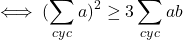
    \[\iff (\sum_{cyc} a)^2 \geq 3 \sum_{cyc}ab\]

    \[\iff a^2+b^2+c^2 \geq ab+bc+ca\]

There are many ways to prove that this final statement is true. We will settle for observing that \frac{1}{2}(\sum_{cyc} (a-b)^2) \geq 0 from which the statement follows.

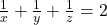
2. For x,y,z \geq 1 such that \frac{1}{x}+\frac{1}{y}+\frac{1}{z}=2, prove that:

    \[\sqrt{x+y+z} \geq \sqrt{x-1}+\sqrt{y-1}+\sqrt{z-1}\]

We begin by writing the condition in a more convenient way. A little algebra yields that the condition is equivalent to

    \[ \frac{x-1}{x}+\frac{y-1}{y}+\frac{z-1}{z}=1\]

By Cauchy-Schwarz, we have that

    \[\sum_{cyc} x=(\sum_{cyc} x)(\sum_{cyc} \frac{x-1}{x}) \geq (\sum_{cyc} \sqrt{x-1})^2\]

    \[\iff \sqrt{x+y+z} \geq \sqrt{x-1}+\sqrt{y-1}+\sqrt{z-1}\]

3. For a,b,c \in \mathbb{R}^+, prove that:

    \[a^3b+b^3c+c^3a \geq abc(a+b+c)\]

By Cauchy-Schwarz, we have that

    \[(\sum_{cyc} \frac{a^2}{c})(\sum_{cyc} c) \geq (\sum_{cyc} a)^2\]

    \[\iff \sum_{cyc} \frac{a^2}{c} \geq \sum_{cyc} a\]

After multiplying both sides by abc, the desired result follows.

Trending