
Introduction
Perhaps one of the most interesting things in group theory is to consider whether two given groups are in fact the same. Even if different symbols are used to denote the elements and operations of the given groups, how can we know if the groups in fact have identical structure? This is precisely the function of group isomorphisms. If there exists an isomorphism between two groups, then we say that the two groups are isomorphic and this means that despite any notational differences, the two perhaps seemingly different groups are in actuality the same. The word isomorphism is derived from the Ancient Greek: ἴσος/isos meaning “equal”, and μορφή/morphe meaning “form” or “shape”.
For two groups  , and
 , we say that
 is a group isomorphism if
 and
 is bijective. In other words, is a bijective homomorphism.
Theorem: On any collection of groups, isomorphism is an equivalence relation
Proof: By considering the function  given by
 , which is an isomorphism, it’s clear that reflexivity is satisfied. Now for symmetry. Suppose that is an isomorphism. There exists a function
 given by
 where
 . It is clear that
 is bijective so now all we have to do is verify that it is a homomorphism. Take any
 and suppose that
 . Then
 ; thus
 , as desired. Now we’ll verify transitivity. Suppose that and
 are isomorphisms. Let
 . It’s rather clear that
 is a bijection (if this isn’t clear to you then take the time to convince yourself of it) so all that remains is to check that it’s a homomorphism. Take any
 . Then
 as desired.


Hence it makes sense to say that two groups are isomorphic; there is no ambiguity apropos of whether is isomorphic to or is isomorphic to . When two groups and are isomorphic, we write 
Examples
Time for some examples. Let’s being by showing that  and
 are isomorphic. We define
 via
 . We first must verify that this is well-defined. If
 , then
 and thus
 and
 . Therefore,
 in and hence the operation is indeed well-defined. Now let’s verify that it’s a homomorphism. If then
 . Now we’ll check that the function is injective. If
 , then
 . That is
 and
 . Therefore,
 and so
 in . Thus
 . As shown in my group homomorphism post, is injective if and only if , and thus must be injective. It’s rather clear to see that is surjective as the
 elements of map to different elements of , but only has elements, and so must be surjective.
Note that it is however not generally true that  is isomorphic to
 . For example,
 is not isomorphic to
 as
 has order
 in however since
 for every
 in , every element must have an order dividing
 , and so the two groups can’t be isomorphic.
Here’s another example. The set  is a group under multiplication that is in fact isomorphic to the additive group
 . Since we’re dealing with groups with only a few elements, in this case it’s plausible to simply define what each individual element gets mapped to in the isomorphism. We define
 via
 and
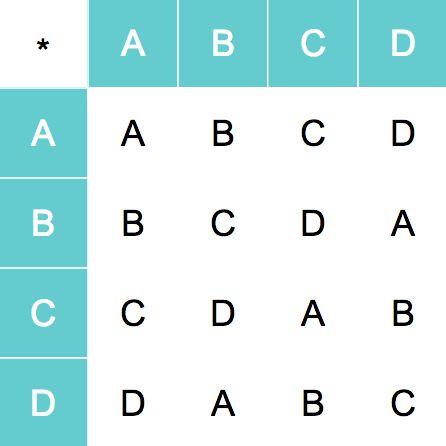
 . The function is clearly bijective and it is perhaps easiest to verify that it respects the group operations by comparing group tables.
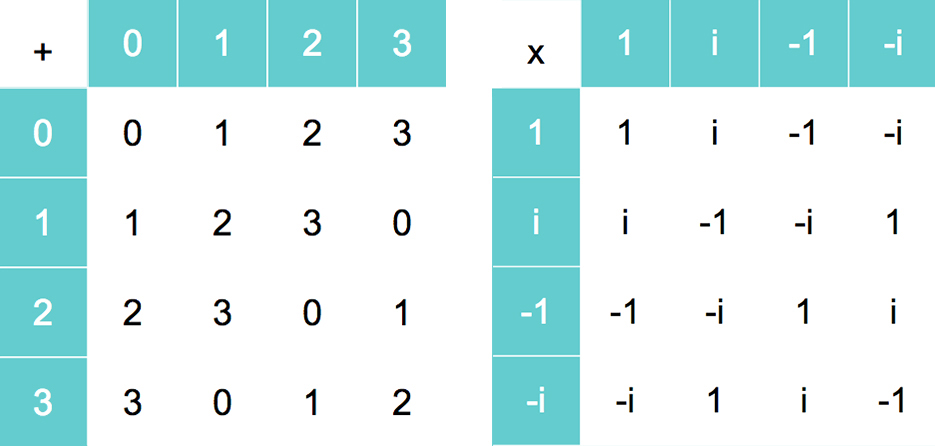
A little inspection reveals that these groups both have group tables of the following form:
General Results
Now I’ll present some more general results, many of which are elegantly surprising.
Theorem: Let  be a cyclic group. If
 has infinite order, then
 and if has order
 , then

Proof: Let be infinite cyclic. Define  via
 . We’ll show that is an isomorphism. If
 , then
 , as required. If
 , then
 . Hence and thus is injective. Furthermore, if
 , then
 , and so is surjective too. Therefore is an isomorphism.
Now suppose that  . Define
 via . In this case, we must verify that is well-defined. But if
 in
 then
 and hence
 . The fact that is a surjective homomorphism follows as above. If then
 and thus
 . Hence,
 in and so is injective. Consequently, is an isomorphism as desired.
An elegant corollary is that if a group has prime order  , then
 . This follows since any group of prime order is in fact cyclic, as shown in my post on Lagrange’s theorem. Take a moment to ruminate on this. Given any group of prime order , we know that its structure is as simple as addition over the integers modulo . No matter how peculiar the group operation may seem and no matter how unfamiliar the notation for the elements might be, when dealing with a group of prime order , we are actually dealing with a group that we are in fact deeply familiar with.
Lemma: Let be a group having distinct commuting elements and  of order
 . Then has a subgroup isomorphic to
 .
Proof: Given the conditions upon and , we can see that  is a subgroup (it contains the identity and it’s easy to verify closure). Also, the four elements are distinct. (It’s clear that
 , and are dinstinct. If
 then
 . If
 then
 . If
 then
 . All of these configurations are impossible). Our claim is that
 . Let
 be given by
 and
 . It’s clear that this function is bijective and running through all possible pairs of group elements, we see that it is also a homomorphism.
Corollary: Every group of order  is isomorphic to either or
Proof: In a group of order , every nonidentity element has order or . If there’s an element of order then is cyclic, and by the previous theorem, is isomorphic to . Otherwise, every nonidentity element has order . A group in which every element has order or is in fact always abelian (the proof is left as an exercise for the reader) and hence by what we showed in the previous lemma, has a subgroup isomorphic to . Given the order of the group, the proof is complete.
Standard Results
Now for some results that are less elegant but are still undoubtedly fundamental in aiding the consolidation of our understanding of isomorphisms.
Proposition: Let and be isomorphic groups. Then:
1. is abelian if and only if is abelian
2. is cyclic if and only if is cyclic
3. For any positive integer  , and have the same number of elements of order
4. For any positive integer , and have the same number of subgroups of order
Proof: Let be an isomorphism.
(1) Suppose that is abelian. Then  . And since
 , this means that is abelian too. But the same can be said for
 .
(2) Suppose that  . Then for any
 , we have that
 for some
 . Then
 . Thus
 . But the same can be said for
(3) Take  of order . As shown in my group homomorphism post,
 divides
 . But by the same argument,
 divides
 . Thus
 . That is, the elements of order in are in one-to-one correspondence with the elements of order in
(4) Let  be a subgroup of of order . Then
 is a subgroup of and is isomorphic to . Hence, it has the same order. If
 is some other subgroup of , then since is injective,
 is a different group. Thus has at least as many subgroups of order as does. But applying
 , we see that has at least as many subgroups of order as does. The result follows.


