Introduction
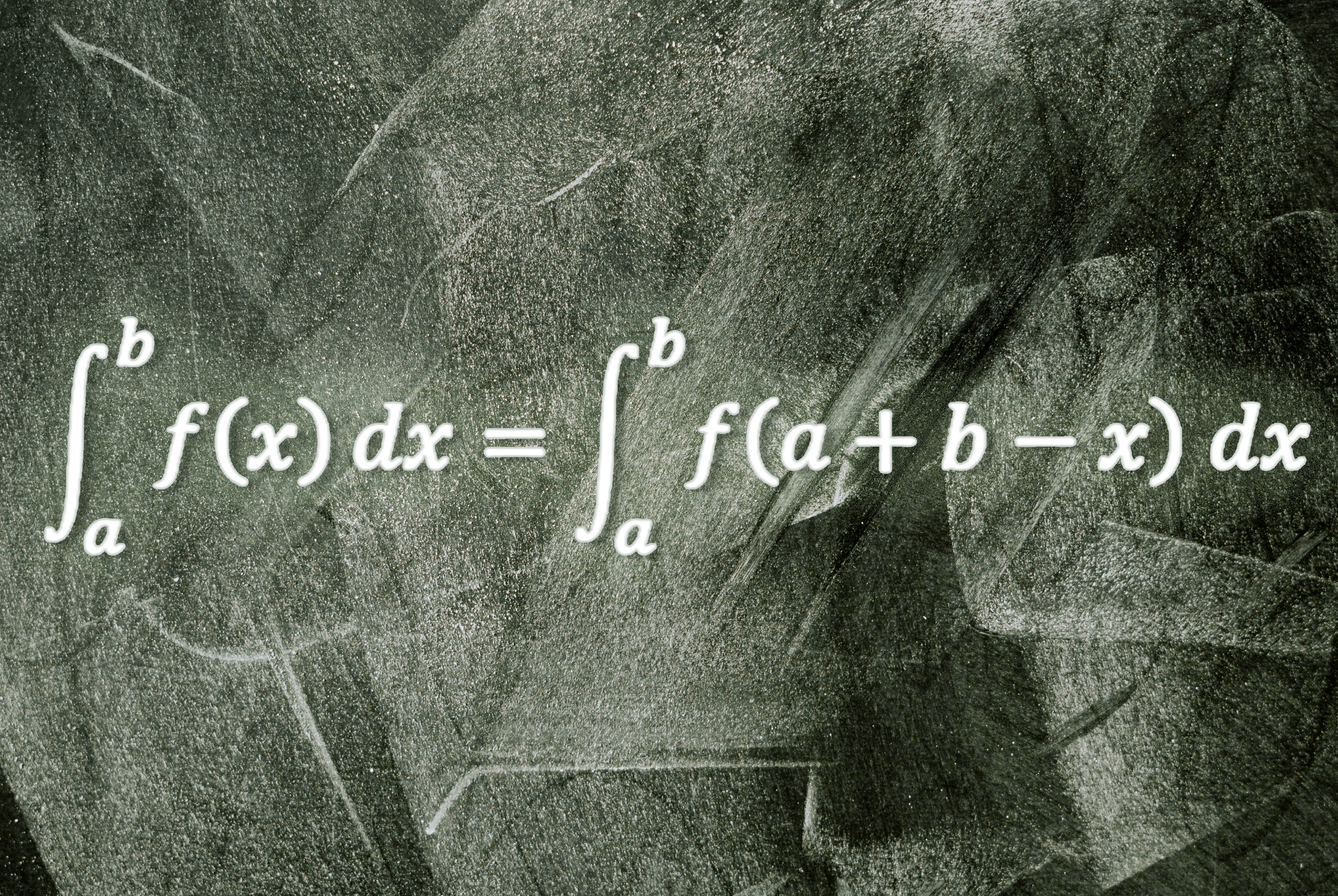
There are various prevalent techniques that can be used to solve the types of integrals which usually arise in competitions such as integration bees. One of the most used and fundamental properties about integrals is commonly referred to as King’s Rule (or the King Property) and is the following:
 =

The result is easily proven; just let  and the integral on the left turns into the integral on the right. Although simple to prove and easy to state, this result is one of the most fundamental in solving difficult integrals and is especially powerful when combined with trigonometric identities.
Examples
I’ll now go through several integrals and provide solutions that involve King’s Rule.
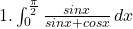
By deploying King’s Rule, we see that

Since  , it follows that

And hence 
Notice that because  and
 , with King’s Rule we can easily solve integrals of the form
 or
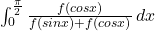 as by using the method shown before, these integrals simply reduce to

So no matter how strange or intimidating an integral looks, if it is of the aforementioned form, it is very easy to solve. For some integrals, however, it is not always obvious that this technique can be used. Consider the following integrals:



Give the integrals a go before viewing the solutions. Remember that we want them in the form previously shown.
The key observation is that  . Following this observation, it is clear that the value of the integral is
 .
A little more thought is required here. A sensible first step is to factorise the denominator; notice that  . As is standard with many integrals that have
 as a factor of the denominator, we now apply the substitution
 , which causes the integral to simplify to
 . Now we continue as we did in question 2 and see that the value of this integral is also
Having done question 3, this question seems a little less intimidating. In fact, it isn’t so hard to change this integral into a form similar to that of question 2. Simply let  and observe that the integral then simplifies to
 . Now we once again let
 and the rest follows as before. Hence the value of the integral is once again
There’s another type of trigonometric integral that can be solved with King’s Rule, however the method is slightly different. Consider the following integral:

We’ll denote the integral as  . The key identity that comes into play is
 . With this identity in mind, we let
 and notice that:

We thus get that 
This is much easier than what we began with. As with practically all integrals, there are several ways of proceeding from here. Here is one potential way of finishing up the problem:
Observe that 
We can now use standard trigonometric integration results to conclude that 

Though all of the examples thus far have been trigonometric, King’s Rule can be used to solve a very wide range of integrals, and I will now try to elucidate this. Firstly, notice that integrals of the form  are simple to solve as upon the substitution
 , we see that
 .
Thus 
And so we see that the earlier result about integrals of the form or is actually a special case of this result. Here are some integrals with solutions that involve this result:

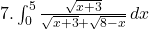
Notice that after the substitutions  and
 , the integrals turn into
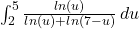 and
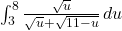 respectively. Now both of these integrals can be solved by a simple application of what we just proved. Given they’re both of the form
 , it’s clear to see that their values are
 and
 respectively.
I’ll now present some more difficult integrals that involve King’s Rule. These will require a little more ingenuity and work but are consequently all the more elegant. Once again, give the problems a go before looking at the solutions.
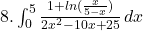
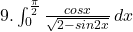
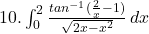

Since the methods we’ve developed thus far rely principally on the bounds of a given integral, a good place to begin with all of these integrals is considering the bounds closely. In all of the solutions, the integral we wish to solve will be denoted as
Given that the upper bound of the integral is 5, it seems sensible to change how the denominator is written in order to incorporate  . Notice that

Let  and observe that

And thus 

The integral is now very simple. Observe that 
Let  . This transforms the integral into


By making the standard substitution  , we see that
 .
Hence 
Given that  , it would be much more convenient to have the denominator in terms of
 . After some rearranging, we see that

Let  . This transforms the integral into


Firstly, notice that  .
By making the substitution  , we see that

Thus 
We now use the very useful fact that  if
 in the given domain. As
 for
 , we can use this identity here.
We thus get that 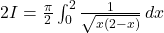


Given the bounds of the integral and the factor of  in the numerator, it is quite clear that we ought to write the denominator as some combination of functions of
 and

Notice that 
By making the substitution  , we see that

Thus 



